IBEX Technology Architecture

Deterministic execution infrastructure for institutional FX markets

IBEX identifies temporary microstructure distortions, then permits participation only when expected normalization edge exceeds live friction, latency, adverse-selection exposure, and survivability constraints. The architecture prioritizes execution integrity, deterministic decision logic, and disciplined capital preservation.

SYSTEM ARCHITECTURE
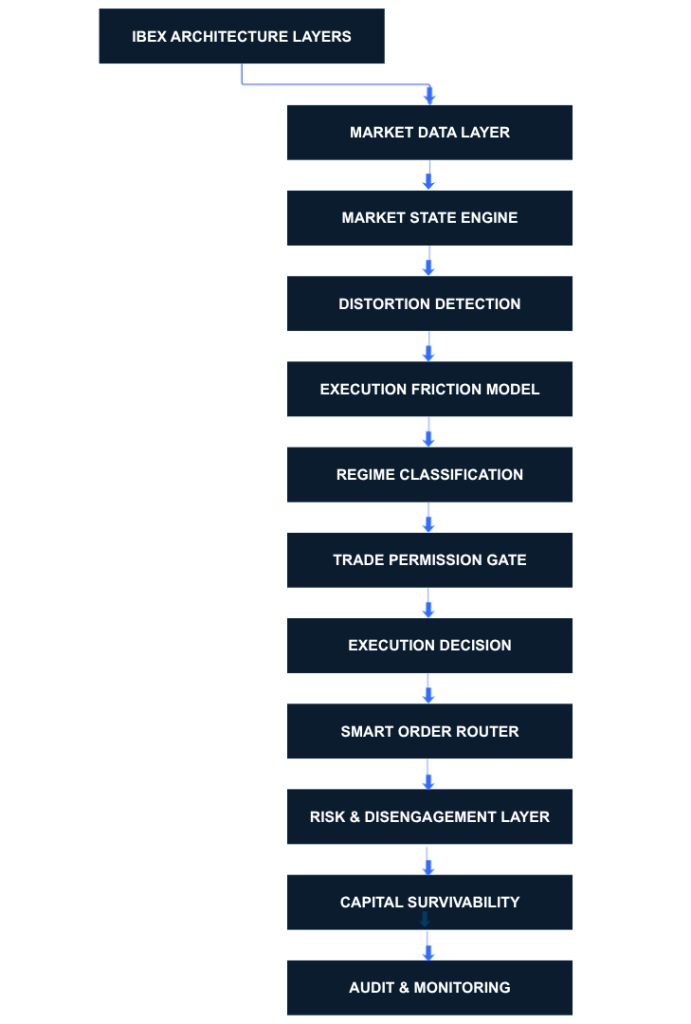
IBEX execution architecture from market-state processing through routing, disengagement, and continuous monitoring

IBEX architecture layers from market-state evaluation through audit and monitoring.

Architecture Logic

A deterministic architecture built to decide when participation remains executable


IBEX is structured as a sequential execution architecture in which each layer performs a specific institutional function: market-state observation, distortion qualification, friction testing, trade permission, execution routing, and survivability control. The system is not organized around prediction. It is organized around whether participation remains economically and operationally viable under real market conditions.

The architecture does not treat detection as permission. It asks whether a distortion remains monetizable after reality.

State Before Action

The architecture begins with live market-state processing. Quote behavior, spread dynamics, available depth, liquidity withdrawal, and cross-pair consistency are evaluated before any potential distortion becomes eligible for qualification.

Friction Before Permission

A qualified distortion does not automatically permit participation. Expected normalization edge is tested against live spread cost, expected slippage, latency exposure, adverse-selection risk, fill uncertainty, and applicable survivability constraints.

Survival Before Continuity

Routing, exposure constraint, disengagement, and capital survivability are integrated directly into the architecture. Participation is reduced or withdrawn when execution integrity no longer remains within permitted tolerances.

SYSTEM INTELLIGENCE

Continuous Market-State
Awareness and Distortion Qualification

IBEX continuously evaluates live market conditions through a structured evaluation layer combining market-state observation, distortion qualification, and regime classification. A detected inefficiency is not assumed to be tradable. It must persist, remain internally consistent, and satisfy live execution requirements before participation can become eligible.

01


Market State Engine

Live L1/L2 data is continuously processed to form a real-time representation of market conditions. This includes price behavior, spread dynamics, liquidity depth, and cross-pair structure.

This state awareness defines the baseline from which any potential distortion is evaluated.

02


Distortion Detection

Temporary dislocations are identified through multiple microstructure measurements, including spread-normalized displacement, liquidity withdrawal, depth imbalance, spread dislocation, and cross-pair consistency.

Only distortions that remain material relative to prevailing market noise and internally consistent across the required measurements proceed to execution qualification.

03


Regime Classification

Market conditions are continuously classified based on both volatility and execution integrity.

Trade permissions are dynamically adjusted across regimes including normal, elevated, stressed, and toxic conditions, ensuring adaptive system behavior.

EXECUTION REALITY

Execution is evaluated before participation is permitted


Before participation is permitted, IBEX evaluates whether expected normalization edge remains economically viable under current execution conditions. The architecture measures live friction, latency exposure, routing viability, fill uncertainty, and adverse-selection risk before granting permission.

Execution conditions evaluated

  • Spread cost
  • Slippage expectation
  • Latency exposure
  • Adverse selection risk
  • Fill probability

The Smart Order Router selects execution venues based on real-time cost efficiency across eligible liquidity providers. Trades are permitted only when expected normalization edge exceeds total execution friction, ensuring that participation remains economically justified after implementation.

This routing logic ensures that opportunities remain economically viable after real execution conditions are considered.

SURVIVABILITY & CONTROL

Capital is Protected Through Conditional Participation and Enforced Disengagement

Risk and survivability controls are embedded directly within the execution architecture. The system continuously evaluates whether participation should continue, reduce, or stop entirely as market state and execution integrity change.

01


Disengagement Logic

Participation is reduced or halted automatically when execution integrity falls outside permitted tolerances. Conditions include latency breaches, slippage spikes, fill instability, spread dislocation, and abnormal liquidity withdrawal.

02


Risk Control Layer

Exposure limits, drawdown controls, and position constraints are enforced at the system level to maintain consistent risk discipline across permitted operating regimes.

03


Capital Survivability

Capital survivability governs the architecture beyond individual trade outcomes. When execution conditions, accumulated exposure, or loss tolerances breach permitted thresholds, the system prioritizes reduction, disengagement, and continuity of capital over continued activity.

The system does not optimize execution. It decides whether execution should occur.

Organizations interested in commercial deployment should explore our White-Label Partnerships framework.